




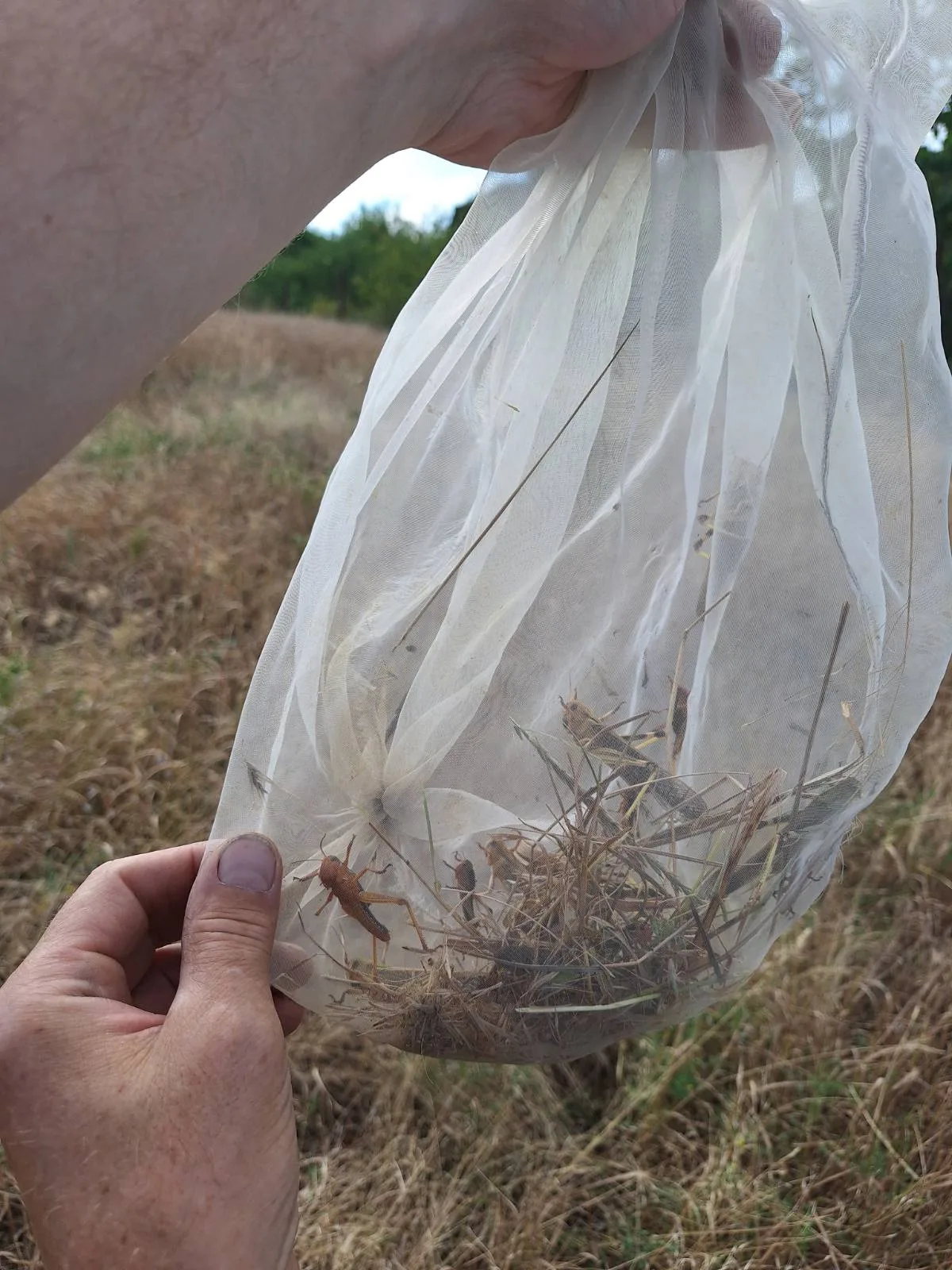
In accordance with the order of the Director of the Institute of Plant Protection of the NAAS of Ukraine, A.V. Fedorenko (Leading Researcher of the Laboratory of Forecasting and Plant Quarantine) and Viktor Romanovych Shyb (applicant for a degree) were sent on a business trip on 23-25.07.2025 to inspect a locust outbreak in Southern Ukraine. On the lands of the Kushumivka territorial hromada, Zaporizhzhia Raion, Zaporizhzhia Oblast, over an area of about 200 ha, locust hotspots were detected with a population density ranging from 40.0 to 100.0 spec./m2 (nymphs and adults), which concentrated in the river floodplains along the Dnipro River and in areas formerly flooded by the Kakhovka HPP. Mass migration of swarms and bands of the pest was also noted across the territory of the hromada, as well as in the Komunarskyi and Oleksandrivskyi districts of the city of Zaporizhzhia.
Staff members of the IPP NAAS conducted population counts at the specified locations (reed beds and fallow lands) and determined the species composition of the existing acridids. The detected adults and nymphs, at a density of 7.0-10.0 spec./m2 (taking into account previous insecticide treatments), belonged to the species Asian migratory locust (Locusta migratoria L.).
The swarms are migrating towards the coast of the Konka River, where there are large expanses of reeds. Complaints about the appearance of the pest are coming from surrounding villages (Yuriivka and Novoselivka, Zaporizhzhia Oblast) located near the demarcation line with the troops of the Russian Federation, but due to hostilities, monitoring by specialists was not carried out there. For the most part, the locusts continue to stay in the reed beds and occasionally colonize and damage agricultural crops.
Since researchers of the IPP NAAS have been systematically monitoring major agricultural pests in Ukraine on a regular basis for many years, and acridids in particular, it should be noted that a similar situation has occurred before. Thus, a population outbreak of this phytophage was recorded on July 12, 2019, in Stanytsia-Luhanska Raion, Luhansk Oblast. In the territories where the pest swarms were noted, counts were carried out and the species was identified as the migratory or Asian locust (Locusta migratoria L.), with a density reaching more than 50.0 spec./m² (the economic threshold of harmfulness for gregarious acridids ranges between 2.0-5.0 spec./m²). Subsequent observations showed that the invasion of this locust swarm occurred from territories beyond the demarcation line with the LPR (from its breeding reservations on abandoned fish farm lands in the territory of the Valuiyskyi Village Council of Stanytsia-Luhanska Raion). These lands turned out to be a large-scale conglomerate of dried-up ponds, drained checks, and overgrown reed wasteland stretching along the Donets River. Since the breeding and distribution hotspots of the locust were located directly on the demarcation line with the LPR, it was impossible to carry out anti-locust measures using agricultural aviation in this zone.
Throughout human history, these insects have posed a serious danger to agricultural crops, as their populations are prone to periodic outbreaks. There are 22 species of acridids living in the territory of Ukraine, belonging to the subfamilies Acridinae, Oedipodinae, Catantopinae, and Acridiinae. It has been established that the structure of the species composition in the acridid community (the share of individual species in locust populations) is variable and depends on many factors, in particular on habitat characteristics or hydrothermal conditions. Periodic mass outbreaks accompanied by significant agricultural damage are characteristic only of locust species capable of existing in two morphophysiological forms—solitary and gregarious—with environmental factors usually triggering the transformation of a population from solitary to gregarious. At the same time, noticeable changes in the morphology, physiology, and ethology of these insects occur. A group of individuals of the same species begins to behave as a single organism characterized by extreme gluttony and migratory activity; they are capable of forming nymph bands (temporary aggregations) or adult swarms.
Ecological features of development in the zone of potential harmfulness
Mass reproduction and spread of the Asian locust are most often associated with a combination of various factors. Thus, it is known that its development is directly dependent on the hydrothermal regime in its habitats. In general, the highest locust numbers in Ukraine are observed in oblasts where the sum of active temperatures (> 50°C) exceeds 3000°C (Kherson, Zaporizhzhia, Donetsk, Luhansk, and Crimea), as well as in regions where the summer surface soil temperature warms up to +28-33°C.
Therefore, an early and warm spring with short-term low floods, a hot summer, and a long warm autumn are the main factors that can lead to mass reproduction outbreaks. Thus, in warm, dry years when the average air temperature during the growing season exceeds 13.8 °C and precipitation does not exceed 320 mm, locust development accelerates and it manages to lay eggs before the cold weather sets in. After 2 years with such conditions favorable to the pest, in the 3rd year there is a high probability of a population outbreak, especially in areas with stations necessary for the phytophage's development.
It is worth noting that the Asian locust is an insect typical of marsh meadows and reed thickets, and is widespread in the floodplains of the Danube, Dnipro, Dniester, and Prut rivers. Therefore, the second decisive factor for a population outbreak is the presence of large reed beds that are beginning to dry out (with the appearance of areas with thinned vegetation cover or completely open ones), which are ideally suited for egg-laying.
Thus, based on the aforementioned facts, there is a high probability of a population outbreak of gregarious acridids next year.
The nature of a sharp increase in locust numbers is always associated with a multifactorial combination of causes. The main determining prerequisite for this is the presence of dried-up reed beds in the region. Also, the emergence of areas with thinned vegetation cover within them, or completely open, well-warmed spots, ideally suited for egg-laying and the formation of egg pods (podiums/egg-pods). Thus, after the destruction of the Kakhovka HPP by Russian troops, large areas that had long been the bottom of the reservoir were freed from water. These moist and warm soils with abundant reed vegetation are, by definition, an ideal reservation for locust development. In addition, one must take into account the presence of a large number of other uncultivated areas and abandoned fields around (due to the war). All this is happening against the backdrop of hot summers, year after year, associated with global warming.
Therefore, although the link between mass locust outbreaks and climate changes has been established for quite some time, the lack of accurate long-term meteorological forecasts and the complete unpredictability of the anthropogenic factor (war), which suddenly and unexpectedly makes its adjustments, makes it impossible to use this knowledge practically (for prediction and prevention).
Recommendations for the eradication of locust hotspots
The main reason for the population outbreak of this pest in 2025 is the impossibility of timely regular monitoring and insecticide treatment of the main phytophage focus, as it was located in partially mined territories where active combat operations are underway. The use of agricultural aviation is also impossible here.
Regarding protection recommendations in this case:
- conducting regular phytosanitary monitoring and subsequent insecticide treatments (if necessary) with preparations specified in the "List of Pesticides and Agrochemicals Approved for Use in Ukraine" in areas of mass locust appearance on territories controlled by Ukraine;
- blank treatments should be carried out only in areas with a high pest density, primarily in agrocenoses and adjacent territories;
- when applying insecticides against a moving band, treatment should cover not only the area actually occupied by the pest, but also ahead of the movement route (at a distance of 200-300 m);
- in the event of colonization of large areas, due to a lack of time or the availability of preparations specified for blank treatment, strip application of insecticides is used. In this case, the width of the treated strips and the gaps between them should not exceed 40-50 m, and their ends are connected by a common treated strip, thus forming a closed network
| Prepared by the Laboratory of Forecasting and Plant Quarantine of the IPP NAAS based on materials from regional institutions of the NAAS and the State Service of Ukraine on Food Safety and Consumer Protection
Halagan T.O. Fedorenko A.V. Bakhmut O.O. Vovkotrub O.M.
|