



Foundation and development
In 1946, the Institute of Entomology and Phytopathology was established within the Academy of Sciences of the Ukrainian SSR on the basis of three laboratories of the Institute of Zoology. Its research programme focused on improving plant protection methods and developing measures against the most dangerous pests and diseases of agricultural crops. In 1956, the institution was reorganized as the Ukrainian Research Institute of Plant Protection, initially under the Ukrainian Academy of Agricultural Sciences at the Ministry of Agriculture of the Ukrainian SSR and later (1962–1969) directly under the Ministry of Agriculture of the Ukrainian SSR. It acquired the status of the Republican Scientific and Methodological Centre for Plant Protection. From January 1970, the Institute was part of the Southern Branch of the All-Union Academy of Agricultural Sciences (VASKhNIL), and from 1992, of the Ukrainian Academy of Agrarian Sciences (UAAS), which received national status in 2010. Today, the Institute of Plant Protection of the National Academy of Agrarian Sciences of Ukraine is the leading institution of the Scientific and Methodological Centre for Plant Protection and coordinates the activities of 15 NAAS institutions.
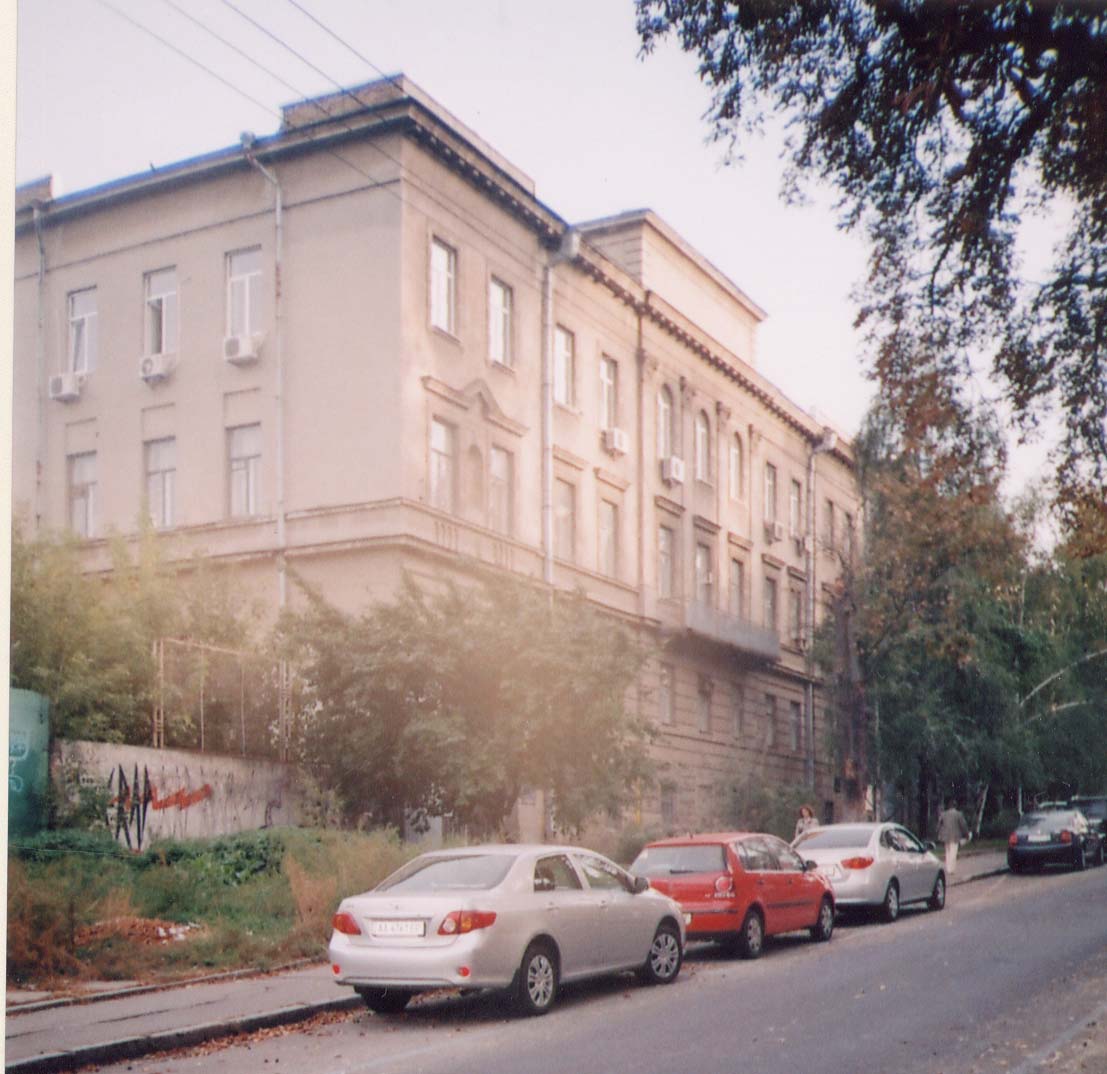
Kyiv, str. Tereshchenkivska, 3 (formerly Repina). On the 3rd floor of this building, until 1963, the scientific divisions of the Institute of Entomology and Phytopathology of the Academy of Sciences of the Ukrainian SSR (Ukrainian Research Institute of Plant Protection) were located.
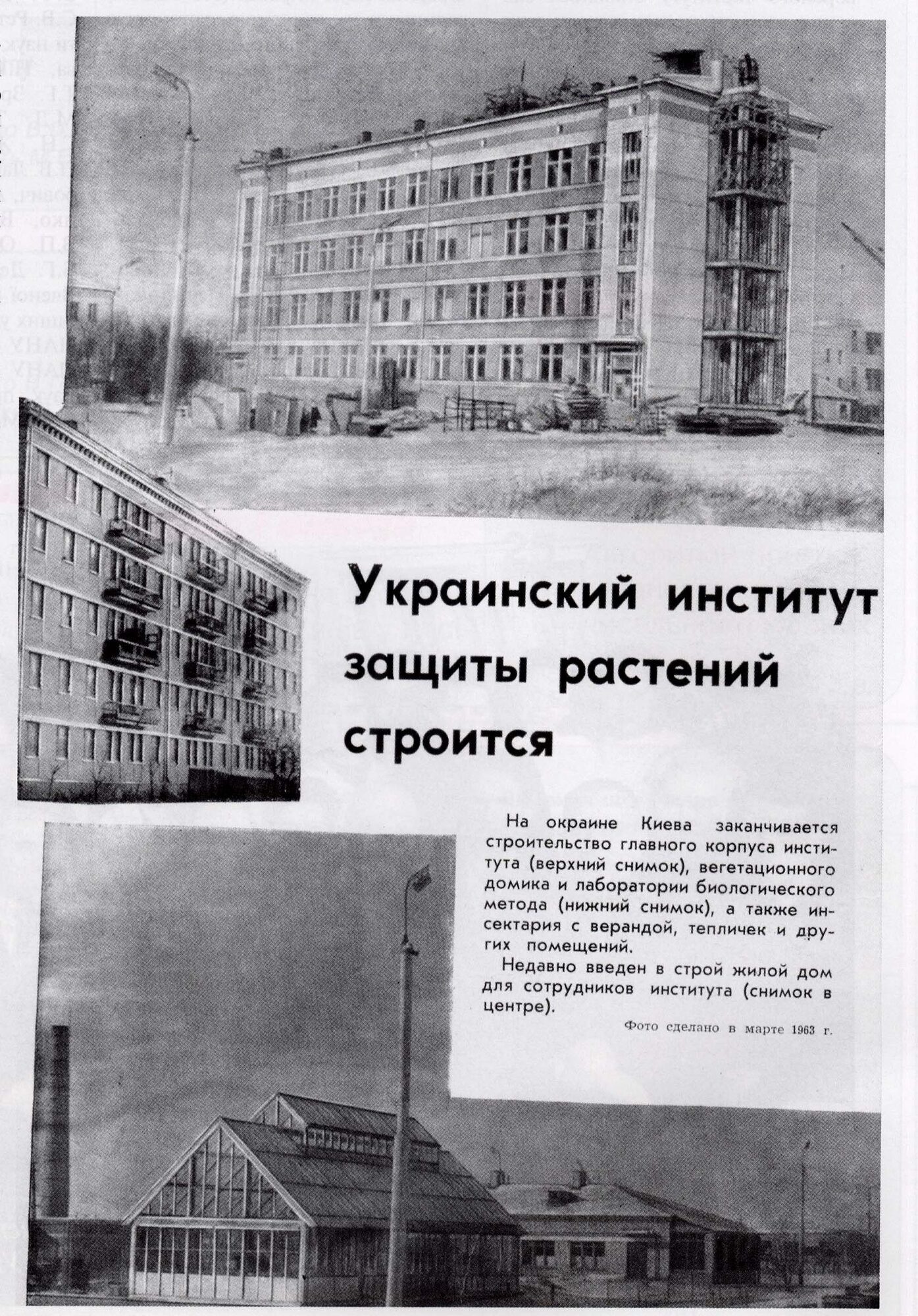
Development of the scientific complex of the Ukrainian Research Institute of Plant Protection (Kyiv, 33 Vasylkivska St.): main building (top), biological method laboratory and vegetation house (bottom), residential building for employees (center). March 1963 (photo from the magazine "Protection of plants from pests and diseases", 1963, No. 7)
Outstanding scientists and directors
The history of the Institute is associated with well-known scientists in biological and agricultural sciences, particularly plant protection. They include NAS of Ukraine academicians V.P. Pospelov and V.P. Vasyliev; corresponding members of the NAS of Ukraine E.V. Zverezomb-Zubovsky, V.P. Muravyov and V.G. Dolin; NAAS academicians V.F. Peresypkin, M.P. Lisovyi, V.P. Fedorenko, O.I. Borzykh and O.O. Ivashchenko; NAS of Ukraine and NAAS academician O.O. Sozinov; NAAS corresponding members D.D. Sigaryova and L.A. Yanse; doctors of sciences Z.S. Golovyanko, M.A. Telenga, A.I. Zrazhevskyi, D.F. Rudnev, Y.S. Kosmatiy, M.P. Dyadechko, V.A. Sanin, B.A. Areshnikov, V.P. Prystavko, G.V. Hrysenko, V.M. Kavetskyi, V.P. Smilyanets, L.I. Bublyk, S.O. Trybel, M.P. Sekun, V.F. Drozda, A.M. Chernii, V.M. Chaika, V.Ya. Maryushkina, S.V. Retman, O.O. Stryhun, H.M. Tkalenko, O.O. Ivashchenko and N.O. Kozub; and candidates of sciences V.L. Tsiopkalo, K.A. Orlachova, N.I. Salunska, M.O. Tselle, T.G. Zrazhevska, V.A. Markhasyova, H.M. Tsybulska, N.V. Lappa, V.M. Goral, E.M. Kititsyn, G.N. Zhigaev, T.O. Prymak, R.S. Krasnytska, K.A. Kudel, I.V. Grihorovych, A.S. Degtyareva, V.I. Shkodenko, V.M. Lopatin, L.M. Shelekhova, O.K. Kondratiuk, A.I. Parfeniuk, V.S. Chaban, S.V. Lysenko, M.P. Honcharenko, M.G. Garnaga, B.G. Degtyarev, V.P. Omelyuta, V.O. Zatserkivskyi, Yu.V. Lahodynskyi, A.M. Voitenko, H.S. Suvorova, Zh.D. Kudina, L.V. Yanishevska, L.V. Yanishevskyi, R.I. Chyzhyk, M.M. Tron, T.M. Kryzhanivska, V.L. Petrunek, L.L. Havryliuk, O.H. Vlasova, M.V. Krut and others.
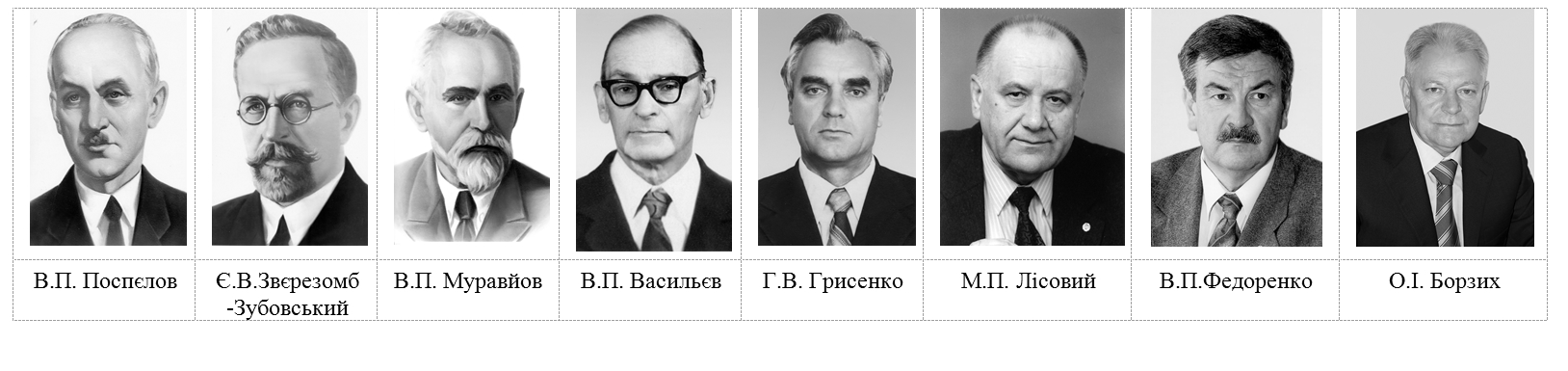
The Institute was headed by: Academy of Sciences of the Ukrainian SSR academician V.P. Pospelov (1946–1948), corresponding members of the Academy of Sciences of the Ukrainian SSR E.V. Zverezomb-Zubovsky (1949–1950) and V.P. Muravyov (1950–1953), Academy of Sciences of the Ukrainian SSR academician V.P. Vasyliev (1953–1979), doctor of biological sciences and professor G.V. Hrysenko (1979–1985), and NAAS academicians M.P. Lisovyi (1986–2003) and V.P. Fedorenko (2003–2011). Since 2011, the director has been doctor of agricultural sciences and NAAS academician O.I. Borzykh.
Scientific achievements
Throughout its history, the Institute of Plant Protection has successfully addressed important tasks in developing effective measures to protect agricultural crops from the most dangerous pests and diseases, particularly by improving chemical protection and developing and introducing biological protection measures. During the 1950s and 1960s, the Institute had specialist laboratories working on the beet weevil (headed by V.P. Vasyliev), the Colorado potato beetle (M.P. Dyadechko, later V.A. Sanin), the sunn pest (B.A. Areshnikov) and tobacco downy mildew (V.A. Markhasyova). These laboratories were disbanded or reorganized after completing their assigned tasks.
Read more
To improve chemical plant protection, the Institute developed and introduced into production: low-volume spraying of field crops and orchards against pests; seed treatment with insecticides to protect seedlings from pests; systems for protecting maize, sunflower, soybean, vegetable crops and potatoes against harmful organisms; technical regulations for applying the current range of pesticides to different crops; and methods for using pesticides together with plant growth regulators and biological products.
Much was also achieved in biological plant protection. The Institute developed and introduced technologies for producing microbial preparations and mass-rearing Trichogramma; combined use of entomophages and biological products against pests of fruit and vegetable crops, and biological products against diseases of cereal and vegetable crops; an integrated system for protecting greenhouse vegetable crops that relies mainly on biological agents; and a method for protecting vegetable crops against harmful organisms in organic production.
Important results of the Institute team's wide-ranging research under academician V.P. Vasyliev include a theoretical justification of the economic value of using insecticides to protect agricultural crops from pests, economic thresholds for the harmfulness of phytophagous organisms, indicators of the environmental safety of chemical protection when pesticide application rules are followed, and the theoretical basis of integrated plant protection against harmful organisms. The practical possibilities for optimal use of organizational and economic, agronomic, immunological, biological and chemical methods of plant protection were also identified.
Extensive work has been and continues to be done to support the breeding of agricultural plants resistant to pathogens and pests. Methods were developed for breeding plants resistant to major pathogens; a map of the distribution of races of the wheat leaf rust pathogen in Ukraine was compiled; rapid methods were developed for assessing and selecting plant forms with group resistance to pathogens, as well as a method for creating complex artificial infection backgrounds. Databases of effective wheat resistance genes against the local leaf rust pathogen population, sources of winter and spring wheat resistance to leaf rust, Septoria blotch, powdery mildew and common bunt, and sources of spring barley resistance to powdery mildew, common bunt and loose smut were created and transferred to the National Centre for Plant Genetic Resources of Ukraine. Together with other institutions, the Institute developed disease-resistant wheat varieties (Demetra, Ekonomka, Myronivska Storichna, MIP Dniprianka and MIP Vilna), a cucumber hybrid (Skvyrskyi 1/27 F1) and a sunflower hybrid (Kyi). Methods were developed for using the resistance mechanisms of wheat, potato, clover, alfalfa and rice accessions, along with unified nine-point scales for assessing their resistance to major pests. Long-term studies of wheat and potato resistance to pests produced a database of modern varieties of these crops for computer modelling of the breeding of varieties with multiple resistance traits.
Scientists also made substantial efforts to address Fusarium head blight, cucumber downy mildew, late blight of potato and tomato, protection of horse chestnut from the horse-chestnut leaf miner, systems for protecting cereal crops from pests, diseases and weeds under intensive cultivation, and the detection, identification and spread of the western corn rootworm.
New research areas and units
As new important plant protection tasks arose, the Institute established corresponding research units. Following the Chornobyl nuclear power plant accident, an agricultural radiology laboratory was established in 1987 and operated for 15 years. The nematology laboratory joined the Institute in 1991, followed by the plant quarantine department in 1992, the herbology laboratory in 2003 and the laboratory of ecological plant genetics and biotechnology in 2004.
In 1992, the Institute's network also gained the Ukrainian Plant Quarantine Research Station, the Research Station for Quarantine of Grapes and Fruit Crops, and the Transcarpathian Territorial Plant Quarantine Department.
Read more
The agricultural radiology laboratory studied the formation of weed species composition and plant pathogen populations on land withdrawn from agricultural use in the 30-kilometre zone around the Chornobyl nuclear power plant, and improved environmentally safe methods of protecting crops under radioactive contamination. The nematology laboratory developed systems for monitoring and controlling parasitic plant nematodes on winter wheat, potatoes, sugar beet, greenhouse vegetable crops and ornamental plants. It also helped develop 50 varieties of potatoes and other crops resistant to nematode diseases. The herbology laboratory compiled data on the harmfulness of weed species in different field crops, forecast crop weed infestation and improved methods of herbicide use.
The plant quarantine department of the Institute of Plant Protection of NAAS and its network developed numerous methodological recommendations and instructions for phytosanitary risk analysis; diagnosis and monitoring of quarantine pests, plant diseases and weeds; surveys of agricultural land and storage facilities for quarantine organisms; testing plant varieties and hybrids for resistance; improving the health of potato varieties and creating a bank of varieties to differentiate potato wart pathotypes and cyst-forming nematode species and races; and studying the immunological basis of parasitism by quarantine plant pathogens.
The Institute also created information and analysis databases titled "Quarantine organisms of fruit crops and grapes absent from Ukraine: potential for acclimatization", "Quarantine nematode species affecting potatoes: potential for acclimatization in southwestern Ukraine" and "Quarantine corn beetle species: potential for acclimatization in southwestern Ukraine"; a web-based database of new harmful organisms; the automated mapping and information system "Interactive Atlas: Plant Quarantine Status of Odesa Region"; and a collection of microscope slides of the most common harmful nematode species, including quarantine species. It developed new national standards in the "Plant Quarantine" series and harmonized existing ones, and developed national phytosanitary risk analysis schemes meeting the requirements of the International Plant Protection Convention and the European and Mediterranean Plant Protection Organization, in line with WTO and EU requirements.
The laboratory of ecological plant genetics and biotechnology studies wheat collection and breeding material using molecular genetic markers and uses these markers to study wheat resistance genes against pathogens and pests. It developed approaches for optimized use of the gene pool of resistant bread wheats in breeding programmes. The winter bread wheat lines it created were transferred to the V.Ya. Yuriev Plant Production Institute, the V.M. Remeslo Myronivka Institute of Wheat of NAAS and Poltava State Agrarian University for breeding work. This contributes substantially to developing resistant varieties, whose use in production simplifies cultivation and reduces pesticide pressure on the agroecosystem by 30–50%.
Scientific schools
At different stages of research into the most important plant protection issues, the Institute formed scientific schools in entomology (led by V.P. Pospelov, Z.S. Golovyanko, M.A. Telenga, D.F. Rudnev, V.P. Vasyliev, B.A. Areshnikov, V.G. Dolin, V.A. Sanin, M.P. Dyadechko, V.P. Prystavko, V.P. Smilyanets, M.P. Sekun, S.O. Trybel, V.P. Fedorenko and V.M. Chaika), phytopathology (V.P. Muravyov, V.P. Peresypkin, M.P. Lisovyi, G.V. Hrysenko, M.M. Kyryk and S.V. Retman), chemistry (Y.S. Kosmatiy), ecotoxicology (L.I. Bublyk), nematology (D.D. Sigaryova), herbology (O.O. Ivashchenko), ecology (O.I. Borzykh) and genetics and biotechnology (Ya.B. Blium).
More details: Scientific schools of the Institute of Plant Protection of NAAS
The Institute today
Today, the Institute of Plant Protection of NAAS has 10 research units. The Research Station for Quarantine of Grapes and Fruit Crops (Odesa), the Ukrainian Plant Quarantine Research Station (Chernivtsi) and the State Enterprise Takhtaulovo Experimental Farm (Poltava) are subordinate to the Institute. It employs 95 people, including 47 research staff (seven doctors of sciences, including two academicians, and 29 candidates of sciences).
Over the last 10 years, scientists at the Institute and its network have obtained 34 patents and five plant variety certificates and produced more than 200 scientific developments, which have been tested and recommended for wide use in production. During this period they also published about 120 books, including monographs, reference books, brochures, recommendations, identification guides, textbooks and manuals for higher education institutions, and more than 1,600 articles in scientific collections, newspapers and journals. In addition, staff published 67 articles indexed in Scopus and Web of Science Core Collection over the last five years.
Read more
For outstanding achievements in developing the theory and practice of plant protection, Institute scientists V.P. Vasyliev, M.P. Lisovyi, N.V. Lappa and V.M. Goral received State Prizes of Ukraine in Science and Technology; V.P. Fedorenko received the I.I. Schmalhausen Prize, and N.O. Kozub received the V.Ya. Yuriev Prize of the NAS of Ukraine. V.P. Vasyliev, M.P. Lisovyi, V.P. Fedorenko and D.D. Sigaryova also hold the honorary title of Honoured Worker of Science and Technology of Ukraine. Academician V.P. Vasyliev received the honorary title Person of the Year (1997). V.P. Vasyliev, S.O. Trybel and M.P. Sekun were awarded state scholarships as outstanding figures in science. On the centenary of the National Academy of Sciences of Ukraine, D.D. Sigaryova and S.O. Trybel received the medal "People's Tribute to Ukrainian Scientists 1918–2018".
The Institute of Plant Protection of NAAS maintains research ties with scientific institutions and companies in more than 20 countries, including Poland, Moldova, Kazakhstan, Georgia, Hungary, Czechia, France, Germany, the Netherlands, Serbia and Montenegro, Croatia, North Macedonia and Israel. The Institute and its network also carry out international projects.
Throughout the 77-year history of the Ukrainian Entomological Society, the Institute of Plant Protection has held a leading position in this public organization. Institute directors and former staff have headed it for most of that time: E.V. Zverezomb-Zubovsky, V.P. Vasyliev, V.G. Dolin and V.P. Fedorenko. Institute employees A.M. Chernii and O.V. Puchkov have also served as vice-presidents of the Society, as O.O. Stryhun does today. Overall, the Society advances entomology and related disciplines while helping address plant protection and environmental issues.
The Institute trains specialists through postgraduate study in field of knowledge 20, Agricultural Sciences and Food, in specialty 202, Plant Protection and Quarantine, and through doctoral study in field of science 16, Veterinary (Agricultural) Sciences, in specialties 16.00.10, Entomology, and 06.01.11, Phytopathology. On 25 April 2025, the Institute of Plant Protection of NAAS received a certificate of accreditation for its educational and research programme "Plant Protection and Quarantine" in specialty 202, Plant Protection and Quarantine. Following changes to the specialty classification, on 19 June 2025 the Institute received an accreditation certificate for this programme in specialty H1 Agronomy (higher education level: Doctor of Philosophy). From 2005 to 2025, the Institute had a specialized academic council for the defence of candidate and doctoral dissertations.
Each year, the Institute organizes professional development courses for agricultural production workers, seminars, webinars, round tables, meetings and scientific conferences. Staff also take part in dozens of Ukrainian and international conferences, symposia, congresses, round tables, field days, working group sessions, seminars, webinars, meetings and sessions. The Institute presents its scientific achievements at Ukrainian and international specialist exhibitions.
The Institute has two Category B publications: the scientific and production journal "Quarantine and Plant Protection" (four issues per year) and the interdepartmental thematic scientific collection "Phytosanitary Safety" (one issue per year).
In 2023, the Institute of Plant Protection of NAAS and the State Service of Ukraine on Food Safety and Consumer Protection signed a memorandum of partnership and cooperation in plant protection and quarantine. Their joint work will help strengthen Ukraine's phytosanitary safety.
The Institute also signed a memorandum of cooperation with the Czech research institution Crop Research Institute. The research focuses on comparative assessment of the phytosanitary condition of cereal crops and the infection of winter wheat seed by plant pathogens in Ukraine and Czechia.
In addition, in 2025 the Institute signed memoranda with the trading company Aspeagro Global (on international cooperation, establishing a framework for joint research, testing and introduction of innovative plant protection products) and with the Yu.I. Kundiiev Institute of Occupational Health of the National Academy of Medical Sciences of Ukraine (on partnership and cooperation, aiming to conduct research together on principles of partnership, mutual benefit and effective use of intellectual and material resources).
On 9–11 June 2025, the Institute of Plant Protection of NAAS passed state attestation in the Agrarian and Veterinary research area and was assigned to Group B. It also received accreditation certificate No. 202357 dated 7 November 2023, valid until 6 November 2028, confirming compliance with DSTU EN ISO/IEC 17025:2019.
Institute specialists assist the State Service of Ukraine on Food Safety and Consumer Protection, agricultural companies, agricultural specialists and amateur gardeners through consultations, research and various analyses.
The Institute offers services including assessment of the phytosanitary condition of agrocenoses; entomological and phytopathological analysis of agricultural seed and planting material; analysis of plant resistance to harmful organisms; surveys of agricultural land, nurseries and greenhouses for nematode diseases; advice on integrated protection of major agricultural crops against harmful organisms; analysis of active ingredients in pesticide products; phytosanitary risk analysis; analysis of the varietal purity of wheat samples; and many other services.